FINEO vacuum insulating glass combines heritage conservation and thermal insulation at the De Bijenkorf luxury department store
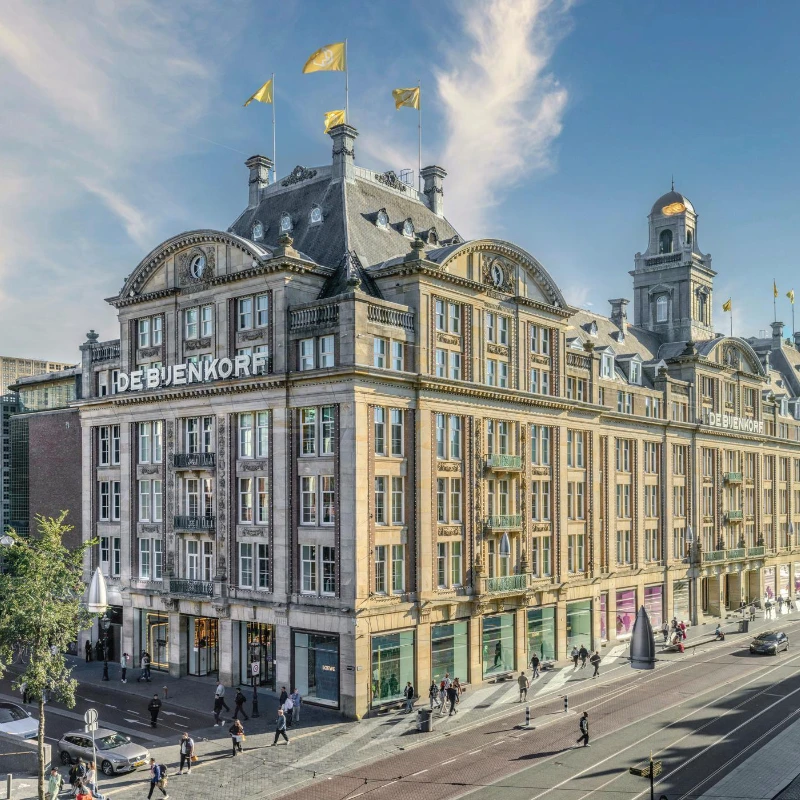
As slim as heritage demands, with the insulation value of triple glazing.
In the late 19th century, luxury department stores of impressive scale and splendour sprang up in all the major European cities. With spacious light-wells and open retail floors, they transformed both the cityscape and the shopping experience. To this day Amsterdam’s De Bijenkorf — Dutch for “the beehive” — is one of those icons and is mentioned in the same breath as Harrods in London, the KaDeWe in Berlin, the Galeries Lafayette in Paris and La Rinascente in Milan. Its architecture is Neoclassical and Neo-Baroque in character and references the baroque design of the Royal Palace opposite on Dam Square in Amsterdam’s historic centre. Unlike many other grand department stores of the period, the windows are classically proportioned and align precisely with the façade grid.
Thermal refurbishment of a nationally listed building using vacuum insulating glass
The building, erected in 1915, was officially listed as a “rijksmonument” (national heritage site) in 1968. The listed status of the building made the thermal refurbishment particularly demanding: the historic windows were preserved in their original form, while the demands in terms of thermal performance and occupant comfort also had to be met. FINEO by AGC vacuum insulating glass with a solar-control coating played a decisive role in this.
This carefully managed, fabric-preserving refurbishment was delivered through close collaboration within a specialist team. Under the direction of project manager Jochem Postulart, property owner CBRE coordinated the implementation and the consultations with regard to energy efficiency and sustainability. Architect Bastiaan van de Kraats of 1m98 Architecten and Oda van den Ende of consultancy De Groene Grachten were responsible for the architectural planning and environmental strategy.
Historic window frames retained
Across Europe, millions of listed buildings present similar retrofit challenges, requiring solutions that satisfy both performance criteria and conservation requirements. At De Bijenkorf, the main task was to replace around 200 large single-glazed windows and numerous smaller panes with thermal insulating glass. Five different window types were used, mainly consisting of wooden windows supplemented by a few steel frames. The aim was to preserve the characteristic appearance of the department store while upgrading its thermal performance. Alterations to the historic window frames were not permitted, which ruled out conventional insulating glass units. FINEO Solar Control vacuum glass provided a solution that preserved the historic façade appearance while improving the thermal performance of the building.
FINEO vacuum insulating glazing could be installed within the existing window frames without altering the frames or increasing glass thickness. This is possible due to the product’s design: two panes of glass separated by a sealed vacuum cavity of just 0.1 mm. This ultra-slim build-up dramatically reduces conductive and convective heat transfer while maintaining minimal thickness.
Even with a total thickness of just 6.7 millimetres in its thinnest configuration, FINEO achieves a Ug value of 0.7 W/(m²K). For comparison, the same Ug value is achieved with a conventional triple-glazing for a thickness of 36 mm (4/12/4/12/4 mm build-up, two low-E coatings and argon-filled cavities). At the same time the visual effect remains neutral. On one hand, the peripheral edge for sealing FINEO is extremely thin and invisible when integrated into the window. On the other hand, no evacuation opening is present on the final glazing. This provides at the end a very clean appearance and high levels of light transmission, so that the façade of De Bijenkorf — even in the FINEO Solar Control variant — remains almost identical in appearance to the original single glazing.
FINEO Solar Control’s mock-up installation secured heritage approval
In listed building projects, coordination with heritage authorities is often challenging. At De Bijenkorf, careful attention to detail was a key success factor, and the process proceeded relatively smoothly. All existing connections and glass elements were precisely measured, and the entire building was scanned and modelled in three dimensions. The new solutions were then coordinated with the heritage authorities and made visible through a mock-up installation on the façade. In particular, colour effects, reflectivity, and overall visual appearance were carefully considered in relation to viewing angle and adjacent glass. This allowed the City of Amsterdam officials to gain an early realistic impression of the final appearance, enabling swift implementation. For better clarity, 1m98 Architecten produced thematic presentations, showing the solutions for each window type in colour-coded form.
The existing glass elements in the façade — float, etched, tempered, laminated, coloured, and coated glass, ranging from four to sixteen millimetres in thickness and often fitted with various interlayers — posed a planning challenge. Based on the mock-up installation, the decision was made to use the FINEO variant with solar-control coating, which combines high light transmission, lower solar heat transmission and excellent thermal insulation. This solar-control glazing with a low Ug value contributes to a more stable and more comfortable indoor climate all year round as well as lower heating and cooling energy demand.
FINEO vacuum insulating glass: slim, light and well insulated
In addition to its slimness and low weight, FINEO Solar Control provides sound insulation as well as high thermal insulation, reducing heat loss through the glazing. Across the FINEO product range, and depending on the configuration, laboratory-tested sound-reduction values of 35 up to 45 dB (Rw) are available. For listed buildings, glazing is often the most suitable measure, since interventions to the façade would be much more extensive and would alter the character of the building to a greater extent.
FINEO by AGC was the first manufacturer to receive CE marking. To document its environmental impacts transparently across the entire life cycle, AGC has had third-party verified Environmental Product Declarations (EPDs) prepared for FINEO with INIES and NMD databases. The FINEO 8 Low-Carbon variant has in particular reached outstanding low-values of 18.9 kg CO2 eq./m² for INIES declaration and 18.5 kg CO2 eq./m² for NMD declaration*.
Clément Lemoine, Product & Market Manager FINEO by AGC, explains:
"Vacuum insulating glass offers high insulation in a very slim build-up configuration. The Bijenkorf project shows that even buildings with historical substance can be fitted with modern insulating glazing without changing their appearance in accordance with architectural and environmental constraints."
(*) GWP-total, modules A1 to A3 (cradle to gate). EPD registered in February 2026 with the Dutch Nationale Milieudatabase (NMD) and in August 2025 with INIES Databases. Both EPD declarations have been done in accordance with EN 15804+A2 and ISO 14025. All available EPDs are listed in "certifications" on www.fineoglass.eu
To meet all your project requirements, FINEO offers a range of specific products, each with its own advantages.
Discover the FINEO products on https://www.fineoglass.eu/product/
Or contact the FINEO team on https://www.fineoglass.eu/contact/
Author’s note: This article also drew on the following piece in De Architect:
https://www.dearchitect.nl/309407/erfgoed-in-balans-dun-glas-maakt-de-bijenkorf-toekomstbestendig